


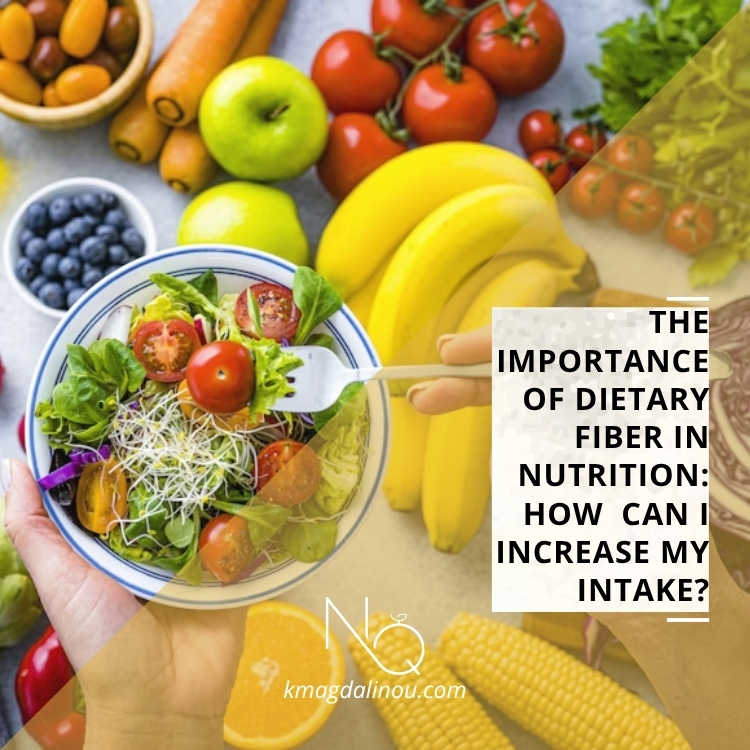

We often hear about dietary fiber and how important it is for our health. In this article, we analyze what dietary fiber is, its benefits, and share ways that can help us consume adequate amounts.
Scientific definition of dietary fiber
Dietary fiber- also known as plant fiber or edible fiber- consists of carbohydrate structures that are neither digested nor absorbed by the human intestine. They include:
(1) non-starch polysaccharides from fruits, vegetables, cereals, and tubers,
(2) resistant (non-digestible) oligosaccharides, and
(3) resistant starch.
Dietary fiber passes through our digestive system intact and reaches the large intestine.
How much dietary fiber should we consume daily?
The recommended daily intake of dietary fiber is 14 grams per 1000 calories. In other words, a person consuming approximately 2000 calories per day typically needs about 28 grams of dietary fiber.
There are many natural foods rich in dietary fiber. According to legislation (EU Regulation No 1924/2006):
“Source of fiber”: a product may carry this claim when it contains at least 3 grams of fiber per 100 grams of product or at least 1.5 grams of fiber per 100 calories.
“High in fiber”: a product may carry this claim when it contains at least 6 grams of fiber per 100 grams of product or at least 3 grams of fiber per 100 calories.
To better understand this, simply check the nutrition labels of products in your cupboard. In the nutrition table, where the values per 100 grams are listed, if the fiber content is above 3 grams or above 6 grams, the product can be classified as a “source of fiber” or “high in fiber,” respectively.
Classification of dietary fiber: soluble and insoluble fiber
An important classification divides dietary fiber into two main categories: soluble and insoluble fiber, based on their solubility in water.
Soluble dietary fiber mixes with water, forming a gel-like substance, and includes inulin, fructans, galactomannans, pectins, and beta-glucans. They are fermented by bacteria in the large intestine, resulting in the production of short-chain fatty acids (SCFAs), which is why they act as prebiotic substances. Other effects include: relieving constipation through the formation of softer, water-rich stools, reducing postprandial glycemic response, lowering total and LDL cholesterol, slowing gastric emptying.
Sources of soluble dietary fiber: oats, citrus fruits, apples, raspberries, lentils, beans, peas, barley, chia seeds, flaxseed.
Insoluble dietary fiber includes cellulose, certain hemicelluloses, lignin, and resistant starch. They absorb water without dissolving in it, thereby increasing stool bulk and preventing constipation. Other effects include: reducing the time food remains in the gastrointestinal tract, reducing insulin resistance, increasing satiety.
Sources of insoluble dietary fiber: whole grain products, wheat bran, brown rice, broccoli, cauliflower, zucchini, leafy green vegetables, cucumber, tomato.
Benefits of dietary fiber
The benefits of dietary fiber for our health and body are numerous.
In Obesity: dietary fiber helps regulate lipid profile, increases satiety without adding many calories, and promotes the production of substances that further enhance fullness.
Scientific explanation: The physicochemical properties of insoluble dietary fiber allow reduced absorption of dietary fat and the removal of cholesterol and bile acids from enterohepatic circulation, improving lipid regulation. Dietary fiber absorbs water and therefore contributes to satiety, leading to lower daily energy intake. In addition, the short-chain fatty acids (SCFAs) produced during fermentation promote the secretion of the hormones GLP-1 and PYY, which contribute to satiety.
In Diabetes Mellitus: Insoluble dietary fiber forms a mesh within the intestinal lumen and delays glucose absorption, thereby improving glycemic regulation. Additionally, dietary fiber increases insulin sensitivity because it slows gastric emptying. It is worth noting that the improved blood glucose regulation associated with fiber consumption is also aided by the production of the hormones GLP-1 and PYY, which increase endogenous insulin secretion.
In Cancer: Dietary fiber increases stool bulk, accelerates bowel movements, and reduces the concentration of carcinogenic substances in the large intestine, thereby lowering the risk of colorectal cancer. At the same time, the role of dietary fiber in the prevention of other forms of cancer, such as ovarian and breast cancer, has also been studied through reduced estrogen production.
In Gastrointestinal Disorders: Imbalance in the gut microbiome can damage the gastrointestinal barrier, increasing susceptibility to certain diseases. The fermentation of dietary fiber in the large intestine promotes the growth of beneficial bacteria at the expense of harmful bacteria. Moreover, the short-chain fatty acids (SCFAs) produced during fermentation inhibit the release of pro-inflammatory factors, thereby protecting the integrity of the gastrointestinal tract. In addition, dietary fiber contributes to the management of constipation, and in patients with non-erosive gastroesophageal reflux disease, it improves esophageal motility and reduces symptoms of reflux and heartburn.
Finally, a negative association has been observed between dietary fiber and heavy metal toxicity, cardiovascular risk, menstrual pain, and allergic symptoms.
How can I increase my dietary fiber intake?
Choose whole grain products at every meal: Increasing daily dietary fiber intake can easily be achieved by replacing ultra-processed breakfast cereals with oats, substituting white bread and pasta with whole grain versions at lunch and dinner, choosing brown rice instead of white rice.
Increase consumption of whole fruits and vegetables: Easy and measurable goals include consuming 2 medium-sized fruits by lunchtime, ideally with the peel, replacing juices and sweet snacks with whole fruits.
Regarding vegetables, it is beneficial to structure lunch and dinner with 1–2 cups of salad containing a variety of vegetables to ensure adequate intake of both soluble and insoluble fiber.
Increase legume consumption: It is recommended to increase legume intake, aiming for at least 2 servings per week. Preparing legumes by boiling them and storing them in the refrigerator makes them easier and more appealing to consume compared to preparing legume soups.
Increase consumption of seeds and nuts: Adding seeds and nuts increases daily fiber intake and satiety. They can be added to yogurt, salads, or consumed as snacks combined with fruit.
Enrich meals with fiber sources: To further increase fiber intake, it is recommended to enrich every meal with at least one fiber source, for example: incorporating vegetables into omelets, rice, orzo, sauces, minced meat, or mashed potatoes, adding 2 tablespoons of legumes to salads, blending legumes and using them as spreads such as hummus, adding grated fruit to homemade preparations such as cakes or pancakes.
SOURCES
- He, Y., Wang, B., Wen, L., Wang, F., Yu, H., Chen, D., Su, X. and Zhang, C. (2022) Effects of dietary fiber on human health. Food Science and Human Wellness, 11(1), pp. 1–10.
- Stephen, A.M., Champ, M.M.-J., Cloran, S.J., Fleith, M., van Lieshout, L., Mejborn, H. and Burley, V.J. (2017) Dietary fibre in Europe: current state of knowledge on definitions, sources, recommendations, intakes and relationships to health. British Journal of Nutrition, 116(4), pp. 1–18.